PaperIn Progress
WAVES — Psychoacoustic Whitepaper
Binaural difference frequencies, vestibular response, and personalisation.
Pending
Project 04 / Flagship — Product · Psychoacoustics
Waveform Activated Vestibular Emotional System
An adaptive psychoacoustic platform designed to support emotional regulation, attention, nervous system recovery, memory reflection, and overall wellbeing — through intelligently designed sound environments. Sound as an interface for emotional wellbeing.
Disciplines
Research
Sound is processed not only by the ear and brain but by the vestibular and autonomic systems. WAVES builds on contemporary research linking specific acoustic structures — frequency, rhythm, spatialisation — to physiological states.
Problem statement
Most existing sound-for-wellbeing products treat the listener as a single, static profile. WAVES treats each listener as a changing physiological context, and adapts.
Design process
The project moves between three working modes: literature review with clinicians, studio composition with sound designers, and prototyping with engineers. Every release is tested against measurable physiological response.
Psychoacoustic principles
WAVES draws on isochronic structures, binaural difference frequencies, spatial localisation cues, and amplitude envelope design — each chosen for its documented effect on attention, arousal, and recovery.
Binaural audio
A controlled difference between the two ears can entrain neural rhythms toward focused, relaxed, or restorative states. WAVES uses binaural beats as one tool among many, never in isolation.
Brainwave entrainment
The goal is not to sedate but to gently shift state — alpha for rest, theta for reflection, beta for focus — using sound design that is musical first, clinical second.
Memory and emotion
WAVES includes a memory mode: ambient compositions tuned to support reflective recall, designed in conversation with therapists and grief workers.
System architecture
The platform pairs a real-time generative audio engine with a personalisation model trained on listener feedback and (opt-in) wearable signals. Sessions are composed, not played back.
User experience
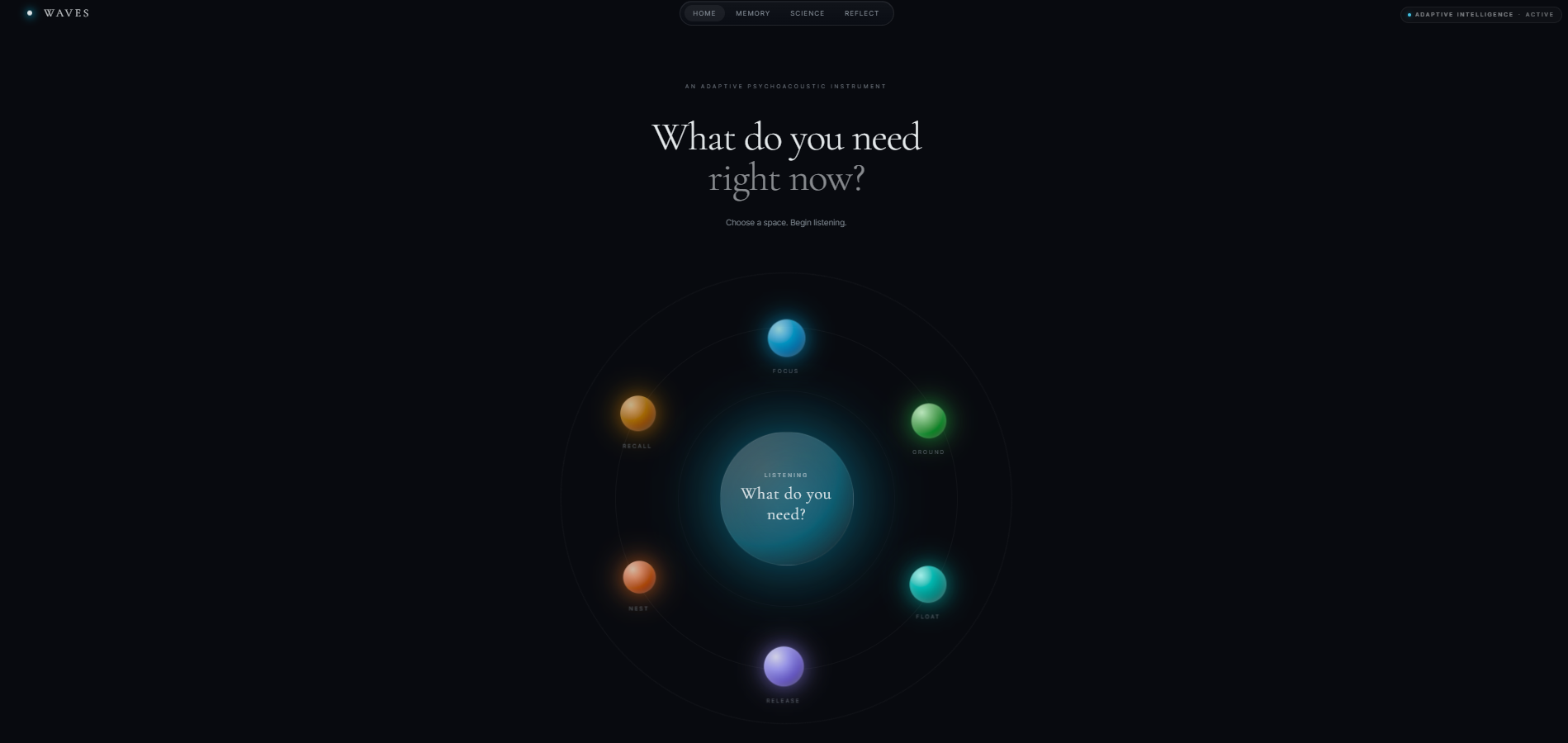
The interface is deliberately minimal — three states, one dial, one timer. The complexity lives under the surface, not on it.
Future vision
The long arc of WAVES is a freely available sonic public health tool — a piece of infrastructure for emotional wellbeing, used in homes, classrooms, clinics, and shared spaces.
Archive · Images
System & sessions
Archive · Audio
Alpha-state session — excerpt
Generative ambient excerpt, 8.4 Hz isochronic carrier. Master coming soon.
Archive · Documents
Binaural difference frequencies, vestibular response, and personalisation.
Protocol designed with collaborating clinicians for the 2025 pilot cohort.
Archive · Links
Archive · Field notes
First listening tests with grief workers
Three sessions in a hospice setting; the memory mode produced longer reflective pauses than the control mix.
Archive · Roadmap
Public demo build
Coming SoonBrowser-based demo of three core sessions — focus, rest, reflection.