Investigation 01 / Active — 2021 → Present
Kaavalar.
Protecting sandalwood ecosystems through indigenous security infrastructure.
- Type
- Investigation · Ecology · Hardware
- Timeline
- 2021 — Present
- Role
- Lead Researcher · Field Engineer
- Location
- Tumkur, Karnataka
- Status
- Active investigation
Themes
Kaavalar began as a question:
How might technology protect forests without replacing the communities that have protected them for generations?
Developed through field research with sandalwood farmers in Karnataka, the project investigates indigenous security systems, ecological stewardship, sensor networks, and distributed monitoring infrastructures designed to safeguard one of India's most valuable and vulnerable ecological resources.
This is not simply a technology project. It is an inquiry into guardianship.
The Problem
A tree worth more than the systems meant to protect it.
Sandalwood cultivation represents a vital economic resource for thousands of farmers across Southern India. Yet the value of sandalwood has created a parallel ecosystem of theft, illegal extraction, and violence.
Farmers are often forced to rely on expensive barriers, guards, or reactive security measures that fail to address the root problem.
Kaavalar investigates how long-term, affordable, community-owned systems might provide resilience without increasing dependence on external actors.
Stakeholder Ecosystem
The tree is held by more hands than it looks.
Sandalwood does not stand alone. It sits inside an ecosystem of farmers, cooperatives, forest officers, traders, processing units, regional markets, customary guardians, and the families whose long-term livelihoods are tied to the canopy.
Early in the project we mapped this network deliberately — not as an org chart, but as a field of overlapping responsibilities. Every later design decision was tested against the question: whose hands does this strengthen, and whose does it sideline?
- ·Sandalwood farmers and family stewards
- ·Local cooperatives and farmer producer organisations
- ·Karnataka State Forest Department
- ·Customary guardians and night-watch networks
- ·Traders, auctioneers, and processing units
- ·Researchers, NGOs, and policy partners
Farmer Stories
What the trees are worth, told by the people who guard them.
"I planted these trees the year my eldest daughter was born. They will outlive me. Anything that protects them protects her too."
"The guards we hire are expensive. The fence is expensive. The fear is the most expensive thing of all."
"If the device only tells the police, it is not ours. If it tells us first, it becomes part of the village."
Security Fatigue
The hidden cost of guarding a tree for thirty years.
Theft is the visible problem. The invisible problem is fatigue. A sandalwood tree matures over decades — and across those decades a family carries the constant, low-frequency cost of vigilance: paying for guards, repairing fences, sleeping lightly, losing trust in neighbours, deciding whether to plant another generation of trees at all.
Any technology that adds to this load fails, no matter how well it performs on paper.
Kaavalar is therefore evaluated against a quieter metric: does it reduce the daily emotional and financial weight of guardianship for the people who already carry it?
Field Research
Listening before building.
The project began through conversations with sandalwood farmers, field visits, stakeholder mapping, market analysis, and technical feasibility studies.
Research focused on
- ·Tumkur district, Karnataka
- ·Sandalwood cultivation practices
- ·Existing protection systems
- ·Forest department policies
- ·Farmer experiences with theft
- ·Long-term sustainability requirements
The objective was not simply to build technology. The objective was to understand the ecosystem surrounding the tree.
System Design
A four-layer protection architecture.
Fig. KAV.A / Layered architecture — schematic
- Layer 01
Motion Guard
Perimeter-based motion detection integrated into existing solar fencing systems.
- Layer 02
Community Surveillance
Partnerships with local security ecosystems and traditional protection practices.
- Layer 03
Tree Ring
Low-power motion sensing infrastructure installed directly on trees.
- Layer 04
Chain Node
Embedded GPS and IoT infrastructure distributed throughout the plantation.
Together these layers form a resilient, distributed security architecture rather than a single point of failure.
Chain Node
The final line of defence.
At the core of Kaavalar sits Chain Node.
A distributed network of GPS-enabled sensor modules embedded throughout sandalwood plantations.
Rather than relying on one central device, the system operates as a mesh of interconnected nodes capable of tracking movement, detecting tampering, and maintaining awareness across large areas.
The architecture prioritizes
- ·Low power consumption
- ·Long operational lifespan
- ·Affordability
- ·Scalability
- ·Community ownership
Prototyping
Building in the field.
The project moved through multiple rounds of experimentation involving:
- ·Raspberry Pi systems
- ·GSM communication modules
- ·NodeMCU ESP8266
- ·GPS NEO 6M modules
- ·Arduino-based testing
- ·Rapid prototyping
Every iteration was informed by constraints encountered on the ground.
These constraints shaped the design.
Systems Thinking — Iceberg Model
Theft is the event. The system is everything beneath it.
- 01 · Events
Theft incidents
Visible occurrences — a tree felled, a fence cut. Most security spending stops here.
- 02 · Patterns
Price spikes · seasonal migration · gaps in presence
Repeating conditions that make events more or less likely across months and years.
- 03 · Structures
Licensing · markets · access to credit · policing
Institutional shapes that produce the patterns. Slow to change, but where leverage lives.
- 04 · Mental Models
The tree as commodity · as kin · as inheritance
The deepest layer — how stakeholders imagine the tree itself. Interventions here are the most durable.
Kaavalar is positioned across all four layers — sensors at the event layer, cooperatives at the pattern layer, policy work at the structural layer, and farmer narratives at the level of mental models.
Design Process
Iterating with the field, not for it.
Each revision of Kaavalar was reviewed with farmers, cooperative members, and forest officers before becoming the basis for the next prototype. The process is closer to ethnographic research than product design — slow, dialogic, and willing to throw away a working prototype if it solves the wrong problem.
- ·Stakeholder mapping and conversation
- ·On-site observation and transects
- ·Constraint capture — power, cost, terrain, maintenance
- ·Bench prototyping in Bangalore
- ·Field deployment in Tumkur
- ·Review with farmers and cooperatives
- ·Refinement and the next revision
The Kaavalar Platform
A platform held by the community, not above it.
Farmer Layer
A lightweight Kannada-first interface — daily status, alerts, and acknowledgements over web and SMS.
Cooperative Layer
Shared visibility across member plantations. Coordinates response, maintenance rotas, and learning between farms.
Steward Layer
Aggregated, anonymised insight for forest officers, researchers, and policy partners — released with farmer consent only.
Keys, alerts, and decisions flow outward from the farmer — not inward from a central authority. The platform is designed so the people closest to the trees see things first.
Future Directions
Where Kaavalar is heading.
The next phase of the project moves from prototype to participatory infrastructure — longer field deployments, an open four-layer reference architecture, a farmer-facing dashboard, and a small policy brief written with cooperatives rather than about them.
Beyond sandalwood, the same model is being explored for other high-value crops and for ecological monitoring more broadly — wherever value, vulnerability, and long stewardship intersect.
Chapter — Field documentation


Impact
Stewardship infrastructure.
Kaavalar imagines technology as a supporting layer beneath existing ecological knowledge.
The goal is not surveillance. The goal is stewardship.
By reducing theft, increasing traceability, and strengthening farmer agency, the project contributes toward:
- ·Economic resilience
- ·Ecological protection
- ·Biodiversity preservation
- ·Community empowerment
- ·Long-term sustainable cultivation
Field note / 14 March 2024
"The forest has its own clock. The sensors record not just data, but the rhythm of the canopy. To protect the tree is to protect the community that guards it."
Archive
Field notes, maps, and prototypes.
A living archive of documents, conversations, build logs, and references — published as each layer of the project is released into the open.
Archive · Images
Tumkur — field documentation
Tumkur — field documentation
Archive · Images
Hardware iterations — workshop record
Hardware iterations — workshop record
Archive · Documents
Papers, reports, downloads
Kaavalar — Research Brief (Vol. I)
Field methodology, stakeholder map, and early findings from Tumkur fieldwork.
Four-Layer Architecture — Technical Whitepaper
System diagram, layer responsibilities, failure modes, and resilience analysis.
Chain Node — Build Notes (rev. 1 → rev. 4)
Bill of materials, mesh protocol notes, power budget, and enclosure drawings.
Farmer Conversations — Field Journal
Edited transcripts and notes from on-site interviews, 2022 — 2024.
Mesh resilience under intermittent GSM
Measured behaviour of the node network across patchy rural connectivity.
Workshop deck — Participatory security systems
Teaching deck used with cooperatives, students, and policy partners.
Archive · Links
External references
Karnataka State Forest Department
Policy and licensing context for sandalwood cultivation.
Indian Council of Forestry Research and Education
Background research on sandalwood ecology and silviculture.
Related — A Declining Commons
Adjacent investigation into ecological loss and shared resources.
Related — Bangalore Lake Systems
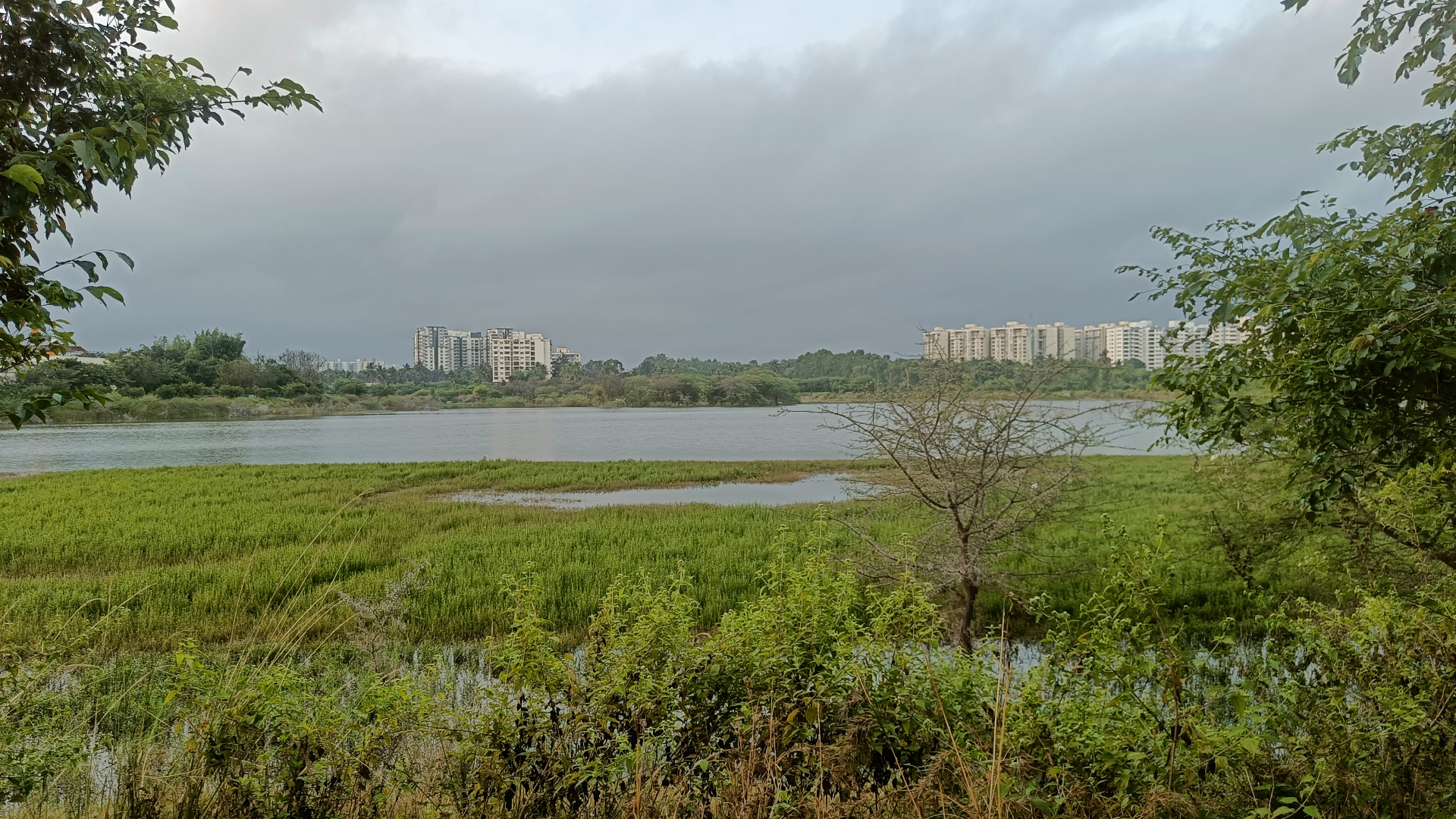
Companion fieldwork on community stewardship of urban ecologies.
Related — FIELD 4
Open-hardware sibling project; shared philosophy of accessible instruments.
Archive · Field notes
From the field
- 2024 · 03
Transect with a senior guardian
Three hours along the southern boundary. He reads the plantation by sound and absence — birds that should be there, footfalls that should not. The sensor network is, at best, a memory aid for what he already knows.
- 2023 · 11
Cooperative meeting — Tumkur
Eleven farmers, two forest officers, one cooperative manager. Consensus on the four-layer model only emerged once 'community surveillance' was named explicitly as a layer of equal weight to the hardware.
- 2023 · 06
Security fatigue
A recurring theme: farmers are exhausted by the cost and emotional load of guarding their own trees. Any new system has to lower that load, not add to it. This reframed our entire UX brief.
- 2022 · 09
First plantation visit
Walked the perimeter at dusk. Solar fence intact, but the back ten acres are effectively unguarded after dark. The geography of theft is not random — it tracks the gaps in human presence.
Archive · Research notes
Reading, thinking, marginalia
- 2024 · 05
Iceberg model — applied to sandalwood theft
Events (theft incidents) sit on top of patterns (price spikes, migration), patterns sit on structures (licensing, market access), structures sit on mental models (the tree as commodity vs. as kin). Interventions at the top of the iceberg are the least durable.
- 2024 · 02
Reading — Elinor Ostrom on commons governance
Re-reading Ostrom alongside Tumkur field notes. The eight design principles for stable commons map cleanly onto what farmers are already doing; our role is infrastructural, not organisational.
- 2023 · 08
On 'participatory security'
Notes towards a paper: distinguishing surveillance (extractive, top-down, opaque) from stewardship (reciprocal, distributed, legible). The same hardware can perform either role depending on who holds the keys.
Archive · Roadmap
What comes next
- —
Chain Node rev. 5 — field deployment
In ProgressTwelve nodes across two cooperating plantations, instrumented for a six-month resilience study.
- —
Public release — four-layer reference architecture
Coming SoonOpen documentation of the layered model so other cooperatives, forest officers, and researchers can adapt it.
- —
Kaavalar platform — farmer-facing dashboard
In ProgressLightweight web and SMS interface designed with cooperatives for daily use, in Kannada and English.
- —
Policy brief — community-owned monitoring
Coming SoonShort document for state forest departments outlining a participatory alternative to private guarding contracts.
- —
Extension — applying the model beyond sandalwood
Coming SoonExploratory work on adapting the four-layer architecture to other high-value, theft-prone crops and to ecological monitoring more broadly.
Related investigations